
 Fleet Solutions
Fleet Insights: Q4 2026
A series on battery reliability, no-start downtime and electrical availability across construction, utilities, transportation, municipal and public safety fleets.

The hidden cost of a dead fleet vehicle.
A dead battery isn't just a battery problem. It's lost technician time, dispatch disruption, roadside response, missed work and management overhead.

Remote vehicles change the battery equation.
A dead battery at a remote site can become a major operational event, especially when help is hours away.

Telematics can tell you where the vehicle is. But can it tell you whether it will start?
Fleet telematics provides valuable data, but a critical piece is often left out: electrical availability.

Aftermarket electronics quietly changed the game.
Cameras, modems, GPS, radios and lighting add value to fleets, but they also add electrical loads OEM systems weren't designed for.

Construction equipment doesn't fail conveniently.
Remote sites, irregular use, harsh conditions and long idle periods make starting reliability critical.

Jump packs are useful tools. But they aren't a fleet strategy.
A portable jump pack can get a vehicle started, but only after someone discovers the problem and gets it to the vehicle.

For fleets, reliable starts require more than a jump pack.
Jump packs are reactive, rely on available staff and equipment, and don't prevent repeat events. Reliable starts require a strategy.

Transportation fleets operate on schedules, not battery schedules.
When a vehicle doesn't start, it's not just a repair. It's a ripple effect across routes, customers and revenue.

Reliable power keeps your equipment, and your projects, moving.
Minimize downtime, keep assets productive, reduce service calls and lower operating costs across your fleet.

What does one no-start actually cost?
It's more than the repair. It's the ripple effect.

Fleet electrification gets attention. 12V reliability deserves some too.

Battery voltage is data, but context makes it useful.
Trends, ignition state, temperature and duty cycle tell a much richer story than a simple low-voltage alarm.

Why jump packs aren't a fleet strategy.
They're useful tools, but only after someone discovers the failure and gets the pack to the vehicle.

What if recovery capability lived with the vehicle?
A smarter way to maintain availability.

When a vehicle doesn't start, the impact goes far beyond the vehicle.
The most expensive part of downtime may be everything around the repair.
The repair can be inexpensive. The coordination, delay and labor often aren't.

The aftermarket electronics ecosystem has a power-management problem.
Great technology. More value. And a more complicated electrical environment.

PST and traditional telematics aren't competitors.
They're a complementary layer focused on electrical availability and recovery.

Predictive maintenance usually focuses on expensive assets.
What about inexpensive failures with expensive consequences?

From voltage monitoring to power-system intelligence.
Trends, detection, notification, recovery and, ultimately, optimization.

Fleet uptime begins before the key turns.
Many availability problems develop while the vehicle sits.
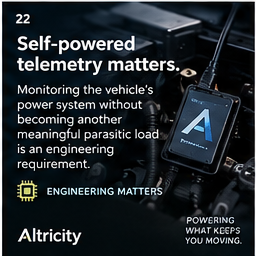
Self-powered telemetry matters.
Monitoring the vehicle's power system without becoming another meaningful parasitic load is an engineering requirement.

We spent a quarter talking to fleet operators.
Here's what we're hearing.

A new fleet metric: electrical availability.
Not just battery health. Not just voltage. Will this asset be electrically ready when you need it?